
Build the network. Keep the business running.
Punch Down is a network engineering sim. You rack the gear, punch down the jacks, configure switches and routers from a real command line, and keep a growing company online when things break.
Coming soon to Steam Early Access
Screens from the game
Every screen below is the game running. Click a picture to see it full size.
In the Early Access build
The 3D view In testing
Walk the building in first person, on the same simulation. Testers have it now. It isn't in the Early Access build yet.
Try a ticket
Real faults from the game. Everything you need is on the screen. Pick an answer.
What's new
Testers get a new build every few days. These are the changes you'd notice, newest first. The full list is in the game under Settings, Version.
Where Punch Down is going
The goal is the closest thing to running a real network without being handed a real rack and a company to keep alive. Everything you learn comes out of the simulation itself: the cables, the packets, the configs and the budget. Nothing is a stat bonus. If you set something up wrong, it fails the way it would at work.
Early Access starts small and solid. Each big update after that adds a layer real companies deal with, and security is where it goes next. Plug into a port to see each stage.
Ready for Early Access Being built now Planned
Early Access
Coming soon to Steam
A full campaign, a career mode and the tools to troubleshoot like you would on the job, on Windows and Linux. The Early Access build now only takes fixes, so it stays stable while 1.0 is built.
Campaign: Harbor Street Dental
Twelve levels, one office that grows with you, from a bare rack to a two-building network. The first three walk you through every step. After that the commands hide behind a button, and from Level 5 you start on hints. Levels 6, 9 and 12 each break something on you to track down.
- First small office: rack, power, console cable, router and switch
- VLANs for the guest kiosk
- Trunks to the clinic wing
- Router-on-a-stick and a central DHCP server
- DNS zones and records
- The Internet: ISP hand-off, NAT and a guest ACL
- Secure remote management over SSH
- New wall jacks, run and punched down
- Wi-Fi with PoE access points
- IP phones and a voice VLAN
- Security cameras on their own VLAN
- Fiber to a second building
Career
Run IT for Northgate Design Studio and Keller & Ross Logistics. Staff move in, new wings open, the budget is tight, and downtime costs the company money. Parts ship next business day unless you pay for express.
Help desk shifts
Work a ticket queue of real faults, easiest first. No red cables giving it away: you find the problem from the symptoms. Build-it-yourself jobs have their own Projects queue.
Tutorials
Short lessons with one goal each: switching, stacking, spanning tree, fiber and optics, DHCP and DNS.
The tools
A real command line on every router and switch, terminals on every PC, CableBird to capture packets, a cable tester and a bench for making your own cables. Port lights work like the real ones: amber at 100 Mb/s, blinking when spanning tree blocks a port, activity only when traffic moves.
In the works
Being built and tested now
These are built, or well on the way, and being tested now. None of it is in the Early Access build yet. Each piece ships in an update once it holds up.
The 3D view Testers have it
Walk the building in first person. Open the server room door, rack a switch with your own hands, patch it, pick up a desk phone and dial the next office. Every cable and port light is the real one from the simulation, the same as in the 2D view.
Career, second edition
- Project budgets, briefs with start dates and a management team that trusts you more, or less
- Things go wrong on their own: a home router on a spare jack, a desk switch loop, a full file server, a cord that only drops out sometimes
- Staff and visitors drive in, park and walk to their desks
- A third company, Brightwater Family Clinic, where the business is patients
New missions
Ferrowick Field Services: inherit someone else's mess, from a plumbers' office to a three-building site. Dead switches, swapped jack labels, a duplex mismatch slowing a whole floor and a run that only fails when it rains.
Harrowgate Data Hall (just started): a data center campaign with hot and cold aisles, A and B power, spine and leaf switching, and the night a cooling unit fails.
Also on the bench
- OSPF, EIGRP, RIP and BGP
- IPv6
- Link aggregation and QoS
- Web management pages on routers, switches and access points
- Network printers
- Rooftop radios aimed by hand
- Day and night
- Simplified Chinese
1.0: Security + Redundancy
Being built now
A lot of networking is keeping traffic moving when something breaks. In 1.0 you build the backup paths yourself, configure them, test them by pulling plugs, and pay for them in career mode.
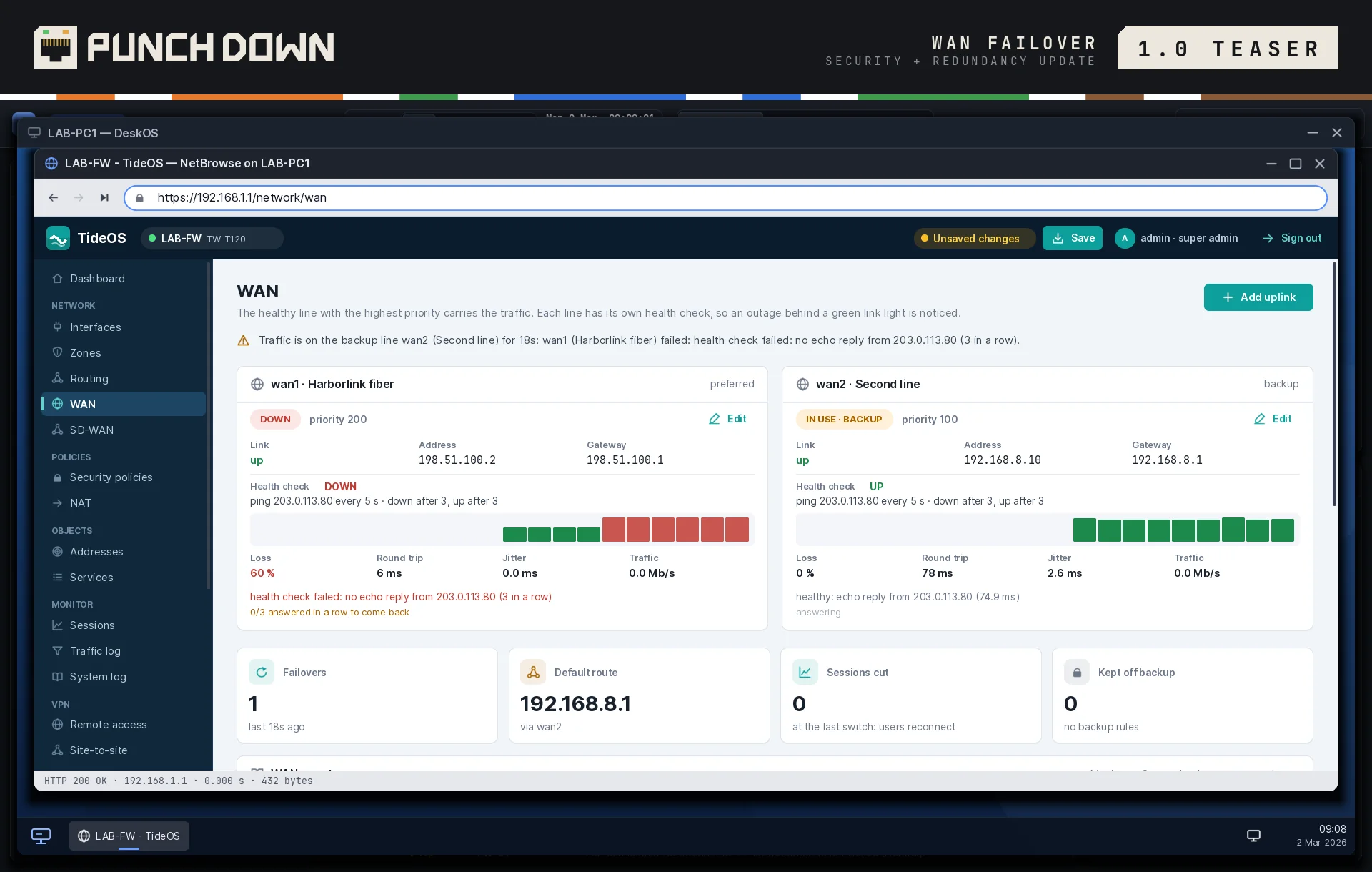
Firewalls
- Firewalls with their own web consoles: zones, policies, NAT, logging
- A small business family and an enterprise family, each with its own workflow
- HA pairs with heartbeat cables. Pull the power on one and watch the other take over
- Site-to-site VPN and remote access with a second factor
Redundancy
- A second Internet line and an LTE backup with real health checks
- MPLS between sites, and carrier repair tickets with real wait times
- Shared paths: two lines in one conduit die together
- SD-WAN rules per app, shared gateways, switch stacks
- Secondary DNS, DHCP failover, UPS, dual power and backups you have to test
Security
- Domain sign-in, group policies and separate admin accounts
- 802.1X on wired and Wi-Fi, port security, DHCP snooping
- A SIEM: forward the logs, triage alerts, call them real or false
- A network sensor and an endpoint agent that can isolate a PC
- Log review missions: work out what an attacker did overnight
Two new campaigns
Linden Row Tax & Insurance 11 levels
A twelve-person office in an old rowhouse. You build it secure from the first cable, and finish your first week working the SIEM queue.
Marlow Precision Parts 15 levels
An office and a factory. You inherit a mess and make it hold up: firewall HA, an MPLS outage on the day a VPN certificate expires, and an intrusion you contain while the line keeps making parts.
After 1.0: more security
Planned
1.0 gives you the security gear. The next step is the job around it: watching a company that runs itself and deciding what's an attack and what's just Tuesday.
Security analyst career
Start on the alert queue of a company that's already built. Sort real incidents from backups and admins doing normal work, build cases, and contain attacks without shutting the business down. Grow into running the security team.
More security tickets
New help desk tickets for the security side: locked accounts, blocked devices, suspicious sign-ins, a USB stick nobody owns.
Exam campaigns
Guided missions that follow the objectives of common networking and security certification exams, so you can study by doing it instead of reading it. The networking pathway already has 85 missions written. A second pathway teaches CableBird, the packet analyzer, from your first capture to finding a fault from both ends of a cable.
Red vs Blue
A strategy card game where one side attacks the network and the other defends it. It's being built now. More on that below.
Red vs Blue: Countermeasures
Being built now, ships after 1.0
A turn-based card game built on the same simulation. Red maps a company network and looks for a way in. Blue hardens it and watches the logs. PvP against a friend, or PvE against the AI. It's playable in development builds and getting a better table and more strategy before it's ready.
Free Play
Planned for around 1.5 or 2.0
No mission list. You're IT and management for a company that starts small. Hire people, add buildings, pick what to spend on and keep it all running for as long as you can.
Red vs Blue
The mode is called Countermeasures, and it's being built now for after 1.0. Two sides, one simulated company. You play cards, not commands: it's about strategy, not typing exploits. Every move runs through the real simulation, so a firewall rule Blue added really does stop Red's scan.
Everything stays inside the game. There are no real hacking tools in Punch Down.
Sample cards from an early concept. Click a card to flip it. Names and rules will change.
Apply to test
We're looking for testers for the Early Access build now, and for the 1.0 security builds later. It helps most if you work in IT, networking or security, or you're studying for it. If you just like sim games, apply anyway.
What testing looks like
- You get each test build before anyone else, for Windows or Linux (Steam Deck works in desktop mode)
- The test build includes the 3D view
- You play, break things and send bug reports
- You tell us when something doesn't act like real gear
Already a tester?
Download the test build with the password we sent you.
Between builds, the devlog and the networking puzzles are posted on r/Punch_Down. For quick questions and challenge votes, join the Discord. Punch Down is also on Facebook, Instagram and TikTok.
Your application is emailed to us at support@novarafrontier.com through FormSubmit. We only use it to contact you about testing.